Introduction to d and f-block Elements
The d-block and f-block elements are parts of the periodic table
that are typically associated with transition metals and inner transition
metals. These elements exhibit unique chemical and physical properties due to
their electronic configurations.
Key concepts covered in this chapter include:
1. d-block Elements: Introduction and its Properties (Electronic Configuration, Valence Electron, Metallic Character, Atomic Size, Ionic Size, Melting Point, Malleability And Ductility, Lustrous Appearance, Coloured Compounds, Magnetic Properties, Reactivity, Alloys Formation, Ionization Energy, Interstitial Compounds)
2. f-block elements: General Introduction, Lanthanides and Actinides and its Properties (Electronic configuration, Atomic size, Ionic size, Oxidation state)
3. Lanthanide Contraction: Its Cause, Consequences and Summary
4. Actinide Contraction: Its Cause, Consequences and Summary
d-block Elements (Transition Metals)
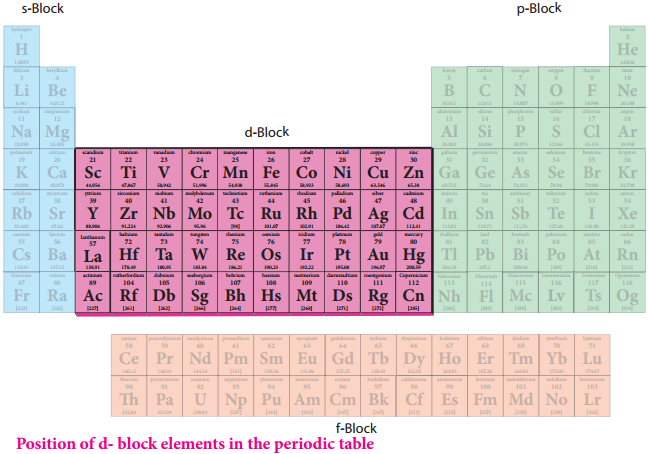
The d-block elements are the elements found in Groups 3 to 12
of the periodic table. These elements are also called transition metals
because they transition between s-block and p-block elements.
General Properties
of d-block Elements (Transition Metals)
The d-block elements, also known as transition metals, have unique
physical properties due to their electronic configuration, which involves
incomplete d-orbitals. Below are the major physical properties of d-block
elements:
2. Valence Electrons1. Electron Configuration
These elements have an incomplete d-orbital in their atoms or ions. The general electronic configuration of these elements is (n-1)d¹⁻¹⁰ns¹-².
3. Metallic CharacterThe valence electrons in these elements are present in both the (n-1)d and ns orbitals. This is one reason they exhibit a wide range of oxidation states.
4. Atomic RadiiAll transition elements are metals except mercury. All are hard, malleable and ductile. They have hcp, fcc and bcc arrangement. Covalent and metallic bonding both co-exist in atom of transition metals. These metals are good conductors of heat and electricity.
5. Variable Oxidation State· Atomic radius of d-block elements decreases with increase in the atomic number from left to right.
Reason: This is due to the fact that an increase in the nuclear charge tends to attract the electron cloud inwards.
· Atomic radii for elements chromium to copper are very close to one another.
Reason: This is due to the fact that simultaneous addition of electron to 3d level exercise the reverse effect by screening the outer 4s electron from the inwards pull of nucleus.
· At the end of the period there is a slight increase in atomic radii.
Reason: It is due to the increased electron-electron repulsion on addition of electron in same orbitals with respect to increased attractive force due to nuclear charge. This causes expansion of electron cloud and hence atomic radius increases.
6. High Melting and Boiling Points· Reason: D-block elements (transition metals) are known for having multiple possible oxidation states, due to the relatively small energy gap between the 3d and 4s orbitals. This allows transition metals to lose electrons from both their outermost 4s orbital and the 3d orbitals, leading to various possible oxidation states.
· Example: Iron (Fe) can exhibit oxidation states of +2, +3, and higher.
- Reason:
D-block elements exhibit high melting and boiling points due to the
strong metallic bonds formed between metal atoms. These bonds are the
result of delocalized d-electrons that are free to move across the
lattice.
- Example:
For instance, Tungsten (W), a transition metal, has one of the
highest melting points of any known element at 3422°C.
7. Malleability and Ductility
- Reason:
Transition metals are generally malleable (can be hammered into
thin sheets) and ductile (can be drawn into wires) due to the
flexibility of the metallic bonds. The ability of the d-electrons to move
and rearrange within the lattice structure contributes to this property.
- Example: Gold
(Au) and Silver (Ag) are very malleable and ductile, making
them easy to shape into coins, jewellery, and thin wires.
8. Lustrous Appearance
- Reason:
Transition metals are shiny or lustrous because of the
ability of their d-electrons to absorb and re-emit light. This
makes them highly reflective.
- Example:
Metals like Gold (Au), Silver (Ag), and Platinum (Pt)
are known for their metallic shine and are often used in decorative
applications, including jewellery.
9. Formation of Coloured Compounds
- Reason:
Transition metals are known for forming a wide variety of coloured
compounds due to the presence of unpaired electrons in their
d-orbitals. The movement of electrons between different d-orbitals (d-d
transitions) in the presence of light gives rise to the colours.
- Example:
- Copper(II)
sulfate (CuSO₄) is blue.
- Chromium
oxide (Cr₂O₃) is green.
- Cobalt(II)
chloride (CoCl₂) is pink.
10. Magnetic Properties
- Reason:
The magnetic properties of d-block elements are largely due to the
presence of unpaired electrons in the d-orbitals. Transition metals
may be paramagnetic (attracted to a magnetic field) if they have
unpaired electrons, or diamagnetic (repelled by a magnetic field)
if all electrons are paired.
- Example:
- Iron
(Fe), Cobalt (Co), and Nickel (Ni)
are ferromagnetic metals, meaning they are strongly attracted to a
magnetic field and can even be magnetized.
- Copper
(Cu) is diamagnetic, meaning it is weakly
repelled by a magnetic field.
11. Low Reactivity (Compared to Alkali and Alkaline Earth Metals)
- Reason:
Transition metals are generally less reactive than alkali and alkaline
earth metals due to their relatively high ionization energies
and the stability of their partially filled d-orbitals. They do not
lose electrons easily, which makes them more stable and less reactive.
- Example: Platinum
(Pt), Gold (Au), and Silver (Ag) are known for their low
reactivity and are often used in jewellery and coins.
12. Alloys Formation
- Reason:
Transition metals easily form alloys (mixtures of metals) because
they have similar atomic sizes and can mix in any proportion. These alloys
often have properties that are superior to those of pure metals.
- Example:
- Stainless
steel is an alloy of Iron (Fe), Chromium
(Cr), and Nickel (Ni).
- Brass is
an alloy of Copper (Cu) and Zinc (Zn).
- Bronze is
an alloy of Copper (Cu) and Tin (Sn).
13. Ionization Energy
- Reason:
Transition metals generally have high ionization energies because
it is harder to remove electrons from their d-orbitals. As you move
across a period in the d-block, ionization energies increase, but the
change is not as significant as in s- and p-block elements.
14. Formation of Interstitial Compounds
Transition elements form interstitial compounds with elements such as hydrogen, boron, carbon and nitrogen.
· Reason: The small atoms of these non-metallic elements get trapped in vacant spaces of the lattices of the transition metal atoms. These spaces present because of their structures and existence of variable oxidation states.
Table 1: Summary of Physical
Properties of d-block Elements:
|
Property |
Explanation |
Example |
|
Electronic
configuration |
(n-1)d¹⁻¹⁰ns¹-² |
Titanium, Copper etc. |
|
Valence
Electrons |
present in both the (n-1)d and ns
orbitals |
V(23):
4s2 3d3 |
|
Metallic
Character |
all are metals except mercury |
Chromium, Iron |
|
Atomic
Radii |
Increases
due to increase in nuclear charge |
rSc>rCr |
|
High
Melting/Boiling Points |
Strong metallic bonds, delocalized d-electrons. |
Tungsten (3422°C) |
|
Malleability
& Ductility |
Flexible
metallic bonds, ability to rearrange. |
Gold
(Au), Silver (Ag) |
|
Lustrous
Appearance |
Light reflection due to delocalized d-electrons. |
Gold (Au), Silver (Ag) |
|
Coloured
Compounds |
d-d
transitions in ions lead to color. |
Copper(II)
sulfate (blue) |
|
Magnetic
Properties |
Presence of unpaired electrons in d-orbitals. |
Iron (Fe), Nickel (Ni) |
|
Low
Reactivity |
High
ionization energies, stable electron configuration. |
Platinum
(Pt), Gold (Au) |
|
Alloys
Formation |
Can easily form alloys with other metals. |
Stainless steel, Brass |
|
Ionization
Energy |
High
due to the stability of d-orbitals. |
Titanium
(Ti), Copper (Cu) |
|
Interstitial
Compounds |
small atoms of C, B, N get trapped in vacant spaces of lattices of
transition metal atoms. |
Brass
|
Conclusion:
The physical properties of d-block elements make them useful in a
wide range of applications, from industrial uses like construction and
electrical wiring to high-end products like jewellery and catalysts. Their hardness,
strength, electrical conductivity, and ability to form complex
compounds are some of the most important characteristics that contribute to
their utility in modern technology and industry.
f-block Elements (Lanthanides and Actinides)
The f-block elements
are located in the two rows at the bottom of
the periodic table, separate from the main body of the table. They consist of
the lanthanides (rare earth elements) and actinides
(which include radioactive elements).
- Lanthanides: These elements include the 14
elements with atomic numbers from 58 (Cerium, Ce) to 71
(Lutetium, Lu). They are also called rare earth elements.
Lanthanides typically show a +3 oxidation state.
- Actinides: These include the elements with
atomic numbers from 90 (Thorium, Th) to 103
(Lawrencium, Lr). The actinides are mostly radioactive
elements, and some of them (like Uranium and Plutonium) are used as
nuclear fuels.

General Properties of
Lanthanides:
1. Electron
Configuration:
These elements are characterized by having electrons
filling the f-orbitals. Their general electronic configuration is (n-2)f¹⁻¹⁴(n-1)d⁰⁻¹ns².
2. High Melting
and Boiling Points:
Lanthanides generally have high melting and boiling
points due to their strong metallic bonding and the involvement of the 4f
electrons in bonding. For example, lanthanum has a melting point of about
920°C, and Lutetium has a melting point of around 1,663°C.
3. Atomic Size
Variation:
The atomic radius of an element refers to the
distance from the nucleus to the outermost electron in a neutral atom.
· Across a Period (Left to Right): As you move across a period from left to right in the transition metals (e.g., from Sc to Zn), the atomic size generally decreases.
Reason: This is due to the increase in nuclear charge, which attracts the electrons more strongly, pulling them closer to the nucleus. Although additional electrons are being added to the d-orbitals, these electrons do not shield the nucleus very effectively, and as a result, the overall attraction between the nucleus and the electrons increases, leading to a smaller atomic radius.
· Down a Group (Top to Bottom): As you move down a group (e.g., from Ti to Cu), the atomic size generally increases.
Reason: This is because additional electron shells are added as you move down the group, which increases the distance between the nucleus and the outermost electrons. Even though the nuclear charge increases, the effect of shielding from inner electron shells reduces the pull on the outermost electrons, causing the atomic radius to expand.
4. Ionic Size
Variation:
Transition metals can form ions with different
charges, such as M2+, M3+ etc. The size of the ionic radius depends on the
charge of the ion and the number of electrons removed or added.
· For a given metal ion, higher oxidation states lead to smaller ionic sizes.
Reason: When a transition metal loses electrons to form cations, the ionic size decreases. This is because the loss of electrons increases the effective nuclear charge per electron, which causes the remaining electrons to be drawn closer to the nucleus. For example, Fe3+ is smaller than Fe2+.
· Across a Period: As you move from left to right across the transition metals, the ionic radius typically decreases for a given charge.
Reason: For instance, comparing ions with the same charge (like Mn2+, Fe2+, and Ni2+), the ionic size decreases as the nuclear charge increases, leading to a stronger attraction between the nucleus and the electrons.
· Down a Group: Ionic sizes tend to increase as you move down a group.
Reason: For example, comparing Ti2+, Zr2+, and Hf2+, the ionic size increases as the number of electron shells increases. The larger number of shells results in more shielding, reducing the effective nuclear charge felt by the outermost electrons.
5. Oxidation state
· +3 Oxidation
State: This is the most stable and predominant oxidation state for lanthanoids,
as it involves the loss of three 4f electrons. All lanthanoids typically form
+3 ions, such as La3+, Ce3+, and Lu3+
· +2 Oxidation State: Some lanthanoids, like Eu and Yb, can also form +2 oxidation states (Eu2+, Yb2+) due to the availability of 4f electrons for loss. This state is less common and typically occurs under reducing conditions.
· +4 Oxidation State: A few lanthanoids, particularly cerium (Ce) and thorium (Th, though not a lanthanoid but often grouped with them), can exhibit a +4 oxidation state, such as Ce4+, due to the loss of an additional electron from the 4f or 5s orbitals.
General Properties of Actinides:
1. Electron Configuration:
The general electronic configuration of actinides can be represented as: Rn5f1-14 6d1-10 7s2
2. Atomic Size:
The atomic size of the actinides (elements from actinium, Ac, to lawrencium, Lr) follows a general trend but with some irregularities due to the unique characteristics of their electron configurations. Here's a brief explanation of the trend in the periodic table:
· Across
the Period (Left to Right): As you move across the
actinide series (from actinium to lawrencium), the atomic size decreases.
Reason: This is because, as protons are
added to the nucleus, the effective nuclear charge increases, pulling
electrons more tightly toward the nucleus. However, the 5f electrons are poorly
shielded, so despite the increasing nuclear charge, the reduction in size
is less pronounced than what you would expect in the lanthanide series (where
shielding is a bit more effective). The overall trend is a gradual decrease
in atomic size across the actinides, but this decrease is less regular
compared to the lanthanides due to variations in how the 5f and 6d orbitals
interact.
· Down the
Group (Top to Bottom): Moving down a group in the periodic table,
the atomic size increases.
Reason: This is because as you move down,
additional electron shells (energy levels) are added, which increases the
distance between the nucleus and the outermost electrons, making the atoms
larger. The shielding effect also increases as the number of inner
electron shells grows, leading to a less effective nuclear pull on the
outermost electrons.
3. Ionic Size
· Across
the period (left to right): As you move across the actinide
series from Actinium (89) to Lawrencium (103), the ionic size generally decreases.
Reason: This
decrease is due to the increasing nuclear charge (more protons) without a
significant increase in shielding by the 5f electrons, causing a stronger pull
on the electrons and a reduction in ionic radius.
· Down the
group (top to bottom): As you move down the actinide series (from Actinium
to Berkelium, and further), the ionic size increases.
Reason: This
happens because, as you go down the group, more electron shells are added,
which increases the distance between the nucleus and the outer electrons,
making the ionic size larger despite the increasing nuclear charge.
4. Oxidation State:
The oxidation states of actinides exhibit trends both across the period and down the group in the periodic table:
· Across
the period (left to right): The oxidation states of actinides
generally increase as you move across the period, especially in their
higher oxidation states.
Early
actinides like Actinium (Ac) tend to show lower oxidation states (+3), while
later actinides like Curium (Cm) and Berkelium (Bk) can achieve higher
oxidation states, up to +6 or +7.
Reason: This
trend occurs due to the increasing availability of 5f, 6d, and 7s electrons for
bonding, allowing for higher oxidation states as the nuclear charge increases.
· Down the
group (top to bottom): Down the group, the most common oxidation state for
actinides is +3, but higher oxidation states are still possible, especially for
the heavier actinides.
The higher oxidation states (e.g., +4, +5, +6) are more common for actinides at the bottom of the series, such as Thorium (Th), Uranium (U), and Neptunium (Np), while lighter actinides like Actinium (Ac) predominantly exhibit +3.
As you go down, the actinides' 5f electrons become more diffuse and less tightly bound, making it easier for these elements to adopt higher oxidation states.
Lanthanoid Contraction
Definition: The lanthanoid contraction refers to the gradual, progressive
decrease in the atomic and ionic radii of the lanthanoid elements (from lanthanum
(La) to lutetium (Lu)) as you move across the lanthanoid series in the periodic
table. This phenomenon occurs despite the fact that electrons are being added
to the 4f orbitals, which might suggest an increase in size. However, due to
the way the 4f electrons interact with the nucleus, the overall size of the
elements decreases as you go from left to right across the series.
Causes of
Lanthanoid Contraction
Increasing Nuclear Charge: As you move across the
lanthanoid series, the number of protons in the nucleus increases by one with
each successive element. This results in an increase in nuclear charge (Z) from
La to Lu. A higher nuclear charge creates a stronger attractive force between
the nucleus and the electron cloud.
1. Poor Shielding of 4f Electrons: The lanthanoids fill their 4f orbitals, and these 4f electrons are not very effective at shielding the outer electrons from the nuclear charge. Unlike the s- and p-electrons, which are more diffuse and spread out, the 4f electrons are more tightly held in the core, making them less effective at shielding the increasing positive charge of the nucleus. This means that as the nuclear charge increases, there is an increased pull on the electrons (including the 4f electrons), and the atom contracts despite the addition of more electrons.
2. Electron Configuration: The electron configuration of the lanthanoids involves filling the 4f orbitals. The electrons in the 4f subshell do not significantly shield each other or the outer electrons, so as more protons are added, the electrons feel a stronger attraction from the nucleus, leading to a decrease in size.
Consequences of
Lanthanoid Contraction
The lanthanoid contraction has several important chemical
and physical consequences:
1. Similar Size of Lanthanoids and Actinoids:
The lanthanoid contraction results in the atomic and ionic radii of the lanthanoids (La to Lu) being quite similar to those of the actinoids (Ac to Lr).
For example, lanthanum (La) and actinium (Ac) have comparable sizes, even though actinium is in the next period. This is because both series have similar electron configurations (f-block elements), and the lanthanoid contraction causes the lanthanoids to contract to sizes comparable to the actinoids.
2. Increase in Ionization Energy and Electronegativity:
The ionization energy and electronegativity of lanthanoids increase as you move across the series. This is a consequence of the increasing nuclear charge, which pulls the electrons more tightly towards the nucleus, making it harder to remove electrons and increasing the attraction for bonding electrons.
3. Similar Chemical Properties:
Because of the lanthanoid contraction, elements in the middle of the lanthanoid series (e.g., Nd, Sm, Eu) are chemically very similar to those near the end (e.g., Yb, Lu). The similar radii make it harder for chemists to distinguish between them based on size, which is why these elements exhibit similar chemical behavior.
4. Influence on Lanthanoid Ions:
Ionic radii of lanthanoid ions (especially in the +3 oxidation state) decrease as you move across the series. This is important because smaller ions tend to form more stable complexes with ligands, and the decreasing ionic size can influence the types of compounds and coordination environments that lanthanoid elements can form.
5. Impact on Lanthanoid Hydrides and Oxides:
The lanthanoid contraction also affects the formation of oxides and hydrides of lanthanoids. The smaller radii in the later lanthanoids (e.g., Lu compared to La) means that these elements tend to form more compact and thermodynamically stable compounds compared to their larger counterparts.
6. Lanthanide Series Contraction and Lanthanide Separations:
The contraction causes smaller differences in atomic radii as you go across the series. This similarity in size can make it difficult to separate lanthanoids from one another using traditional methods like ion exchange chromatography, as the later lanthanoids (like Dy, Er, Lu) are very similar in size and behavior to the earlier lanthanoids (like Ce, Pr). Special methods are used to separate lanthanoids based on slight differences in their chemical properties (e.g., complex formation, redox potentials, etc.).
Summary of
Lanthanoid Contraction
Cause: The lanthanoid contraction is caused by the increase
in nuclear charge across the series and the poor shielding of the 4f electrons,
resulting in a greater pull from the nucleus, which causes the atomic and ionic
sizes to decrease.
Consequences:
1. Similar size of lanthanoids and actinoids.
2. Increased ionization energy and electronegativity across the series.
3. Similar chemical properties among lanthanoids due to comparable sizes.
4. Smaller ionic radii in later lanthanoids leading to more stable complexes.
5. Challenges in separating lanthanoids due to their similar radii.
Actinide Contraction
Definition: Actinide contraction refers to the gradual decrease
in the atomic and ionic radii of actinide elements (atomic numbers 89 to 103)
as you move from actinium (Ac) to lawrencium (Lr). This phenomenon is similar
to the lanthanide contraction observed in the lanthanide series.
Causes of Actinoid
Contraction
1. Increasing Nuclear Charge: As you progress through the actinides, the number of protons in the nucleus increases, leading to a greater positive charge that attracts the surrounding electrons more strongly.
2. Poor Shielding by f-Orbitals: The 5f electrons in actinides provide less shielding of the nuclear charge compared to d and s electrons. This inefficiency results in a stronger effective nuclear charge felt by the outer electrons, pulling them closer to the nucleus.
Consequences of
Actinoid Contraction
1. Chemical Properties: The contraction affects oxidation states and chemical reactivity. Actinides generally exhibit a wider range of oxidation states due to the influence of the 5f electrons, leading to diverse chemistry.
2. Complex Formation: The smaller ionic radii impact how actinides form coordination complexes with ligands. This affects the stability and geometry of these complexes.
3. Physical Properties: Trends in melting and boiling points, as well as ionization energies, reflect the contraction, influencing how these elements behave in various applications.
Summary of Actinoid
Contraction
Actinide contraction is a significant concept in understanding the chemistry of actinide elements. It arises from the combined effects of increasing nuclear charge and poor shielding by f-orbitals, leading to smaller atomic and ionic sizes. This contraction has profound implications for the chemical behavior, coordination chemistry, and physical properties of these elements, highlighting the intricate relationships between atomic structure and elemental characteristics. Understanding actinide contraction is crucial for predicting the behavior of these elements in both fundamental and applied chemistry.

No comments:
Post a Comment