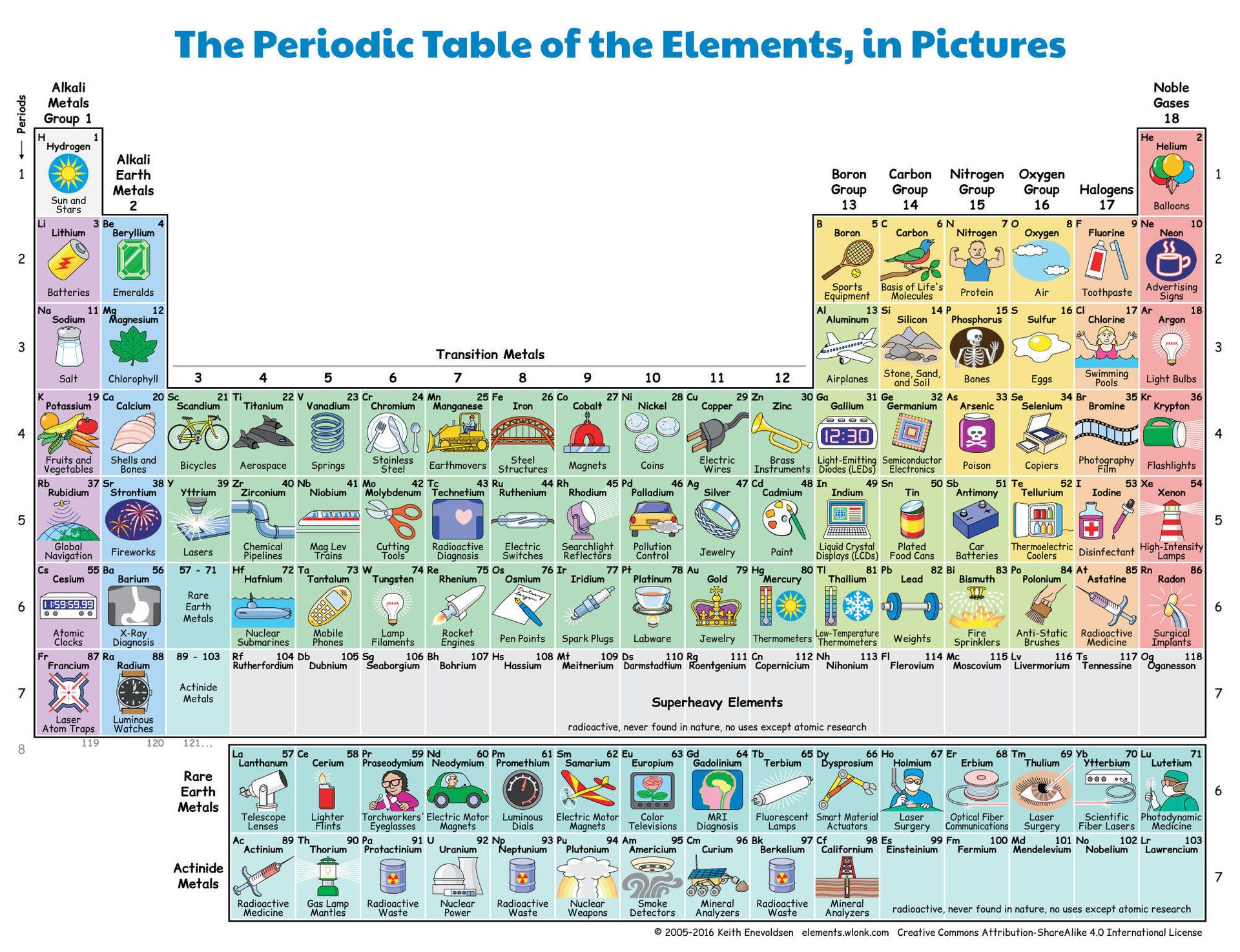
The periodic table is one of the most important tools in chemistry, organizing all known elements in a way that reveals patterns in their properties and behaviours. Developed by Dmitri Mendeleev in the 19th century and later refined, the table arranges elements in order of increasing atomic number, which is the number of protons in an atom’s nucleus.
The table is structured in rows called periods and columns called groups or families. Elements in the same group share similar chemical properties, while those in the same period exhibit a gradual change in properties. Understanding the periodic table helps us predict how elements will react and interact with one another.
Key concepts covered in this chapter include:
- Atomic Structure: Understanding protons, neutrons, and electrons.
- Need of the Periodic Table
- Genesis of the Periodic Table
- Element Classification: Metals, non-metals, and metalloids.
- Elemental classification: s-block, p-block, d-block, and f-block
- Trends in the Periodic Table: Atomic radius, ionic radius, ionization energy, electron gain enthalpy and electronegativity
- Significance of Groups: Alkali metals, alkaline earth metals, halogens, and noble gases.
By exploring the periodic table, students gain valuable insights into the building blocks of matter and the fundamental principles that govern chemical interactions. So, let’s start….
Need of the Periodic Table
The classification of elements in the periodic table is essential for organizing knowledge, predicting chemical behavior, facilitating education, and supporting scientific research. It serves as a fundamental framework for understanding the vast array of elements and their interactions, making it a cornerstone of modern chemistry and many applied sciences.
Genesis of the Periodic Table
The genesis of periodic classification is a fascinating journey through the history of chemistry, marked by the efforts of several key scientists. Here’s a brief overview:
1. Early Attempts (Before 1800s)
- Alchemical Roots: In ancient times, alchemists attempted to classify materials based on their properties, focusing on the transformation of substances.
- Law of Triads: Johann Wolfgang Döbereiner (1829) proposed the Law of Triads, noting that groups of three elements with similar properties had atomic weights that formed a pattern. For example, he observed that lithium, sodium, and potassium exhibited similar behaviors.
Table 1: Dobereiner’s Triads
Element | Atomic weight | Element | Atomic weight | Element | Atomic weight |
Li | 6.9 | Ca | 40.1 | Cl | 35.5 |
Na | 23 | Sr | 87.6 | Br | 79.9 |
K | 39.1 | Ba | 137.3 | I | 126.9 |
2. Newlands' Law of Octaves (1865)
- John Newlands: He arranged the known elements by increasing atomic weight and noted that every eighth element exhibited similar properties, analogous to musical octaves. This was an early attempt to establish a periodicity in elemental properties.
Table 2: Newlands’ Octaves
Element | Li | Be | B | C | N | O | F |
Atomic Mass | 7 | 9 | 11 | 12 | 14 | 16 | 19 |
Element | Na | Mg | Al | Si | P | S | Cl |
Atomic Mass | 23 | 24 | 27 | 29 | 31 | 32 | 35.5 |
Element | K | Ca |
|
|
|
|
|
Atomic Mass | 39 | 40 |
|
|
|
|
|
3. Mendeleev's Periodic Table
- Periodic Law: Often credited as the father of the periodic table, Dmitri Mendeleev organized elements by increasing atomic weight and grouped them based on similar chemical properties.
Table 3: Mendeleev's Periodic Table

· His work led to the formulation of the periodic law, stating that the properties of elements are a periodic function of their atomic weights. He left gaps for undiscovered elements, predicting their properties, which would later be validated (e.g., gallium and germanium).
4. Moseley's Contribution (1913)
- Henry Moseley: Through X-ray experiments, Moseley determined that atomic number (the number of protons) is a more accurate basis for the periodic arrangement than atomic weight. His work corrected some discrepancies in Mendeleev's table and established the modern periodic law, stating that the properties of elements are periodic functions of their atomic numbers.
5. Modern Periodic Table
- Refinement and Expansion: The periodic table has been expanded and refined with the discovery of new elements, including lanthanides and actinides, and the development of quantum mechanics, which further elucidated the behavior of electrons in atoms.
- Current Classification: Today, the periodic table is organized by atomic number, electron configuration, and recurring chemical properties, categorizing elements into groups (alkali metals, halogens, noble gases, etc.) and blocks (s, p, d, f).
- We conclude that, the periodic classification of elements evolved through the contributions of various scientists, leading to the comprehensive and systematic organization we use today. It reflects the historical progression of chemical knowledge and understanding of atomic structure, serving as a foundational tool in chemistry and related fields.
 |
Figure 1: Modern Periodic Table
The Fundamental Particles of an Atom:
Protons, neutrons, and electrons are the fundamental particles that make up atoms. These particles are essential to the structure of atoms and the basis of chemistry.
1. Protons:
· These are positively charged particles, found in the nucleus of an atom.
· They determine the atomic number and thus the identity of an element.
· Protons were discovered by Ernest Rutherford.
2. Neutrons:
· These are neutral particles that also reside in the nucleus alongside protons.
· They contribute to the mass of the atom but do not affect its charge.
· Neutrons were discovered by James Chadwick.
3. Electrons:
· These are negatively charged particles that orbit the nucleus of an atom.
· They play a key role in chemical bonding and reactions.
· The concept of the electron was developed by J.J. Thomson.

Element Classification: Metals, non-metals, and metalloids
Element classification in the periodic table divides elements into three main categories: metals, non-metals, and metalloids.
1. Metals:
·
Found on the left side and in the centre of the
periodic table.
·
Typically shiny, malleable and good conductors of
heat and electricity.
·
Most metals tend to lose electrons and form
positive ions.
2. Non-metals:
·
Found on the left side and in the centre of the
periodic table.
·
Typically shiny, malleable and good conductors of
heat and electricity.
·
Most metals tend to lose electrons and form
positive ions.
3. Metalloids:
·
Located on the right side of the periodic table.
· Usually dull, poor conductors, and can be gases,
liquids, or solids at room temperature.
·
Non-metals tend to gain or share electrons in
chemical reactions.

This classification helps predict the behavior and reactivity of elements based on their positions in the periodic table.
Elemental classification into s-block, p-block, d-block, and f-block
Elemental classification into s-block, p-block, d-block, and f-block refers to the arrangement of elements in the periodic table based on the electron configuration of their outermost electrons. Here’s a brief overview of each block:
1. s-block Elements:
·
Location: Groups 1 and 2 (including
helium).
·
Characteristics: These elements have their
outermost electrons in the s-orbital. They include alkali metals (Group 1) and
alkaline earth metals (Group 2). They are typically highly reactive, especially
the alkali metals.
2. p-block Elements:
·
Location: Groups 13 to 18.
·
Characteristics: These elements have their
outermost electrons in the p orbital. This block includes a diverse range of
elements, including non-metals (like oxygen and nitrogen), metalloids (like
silicon and germanium), and metals (like aluminum and lead). Their reactivity
varies widely.

3. d-block Elements:
·
Location: Transition metals, found in
Groups 3 to 12.
· Characteristics: These elements have their
outermost electrons in the d- orbital. They are typically good conductors of
heat and electricity, often form colourful compounds, and have variable
oxidation states. Transition metals include iron, copper, and gold.
4. f-block Elements:
·
Location: Lanthanides and actinides,
placed at the bottom of the periodic table.
· Characteristics: These elements have their outermost electrons in the f- orbital. They include rare earth elements (lanthanides) and radioactive actinides (like uranium and plutonium). They often exhibit complex behavior and are used in specialized applications.
This classification helps in understanding the properties and reactivity of elements based on their electron configurations.
Trends in the Periodic Table
A detailed explanation of the trends in the periodic table concerning atomic radius, ionic radius, ionization energy, electron gain enthalpy, and electronegativity:
1. Atomic Radius
- Definition: The atomic radius is a measure of the size of an atom, typically the distance from the nucleus to the outermost electron shell.

- Trend Across a Period:
- Decreases from left to right: As you move across a period, protons are added to the nucleus, which increases the nuclear charge. Electrons are also added, but they are added to the same principal energy level. The increased positive charge pulls the electrons closer to the nucleus, resulting in a smaller atomic radius.
- Trend Down a Group:
- Increases from top to bottom: As you go down a group, additional electron shells are added (i.e., higher principal quantum numbers). This increases the distance between the outermost electrons and the nucleus. Even though the nuclear charge also increases, the effect of added electron shells outweighs it, resulting in a larger atomic radius.

2. Ionic Radius
- Definition: The ionic radius is the effective radius of an ion in a crystal lattice, influenced by its charge and electron configuration.

- Cations (Positive Ions):
- Trend: Cations are generally smaller than their parent atoms. When an atom loses one or more electrons, it has fewer electron-electron repulsions, and the remaining electrons are pulled closer to the nucleus due to the increased effective nuclear charge.
- Anions (Negative Ions):
- Trend: Anions are generally larger than their parent atoms. The addition of electrons increases electron-electron repulsion in the outer shell, which pushes the electrons further apart, leading to an increase in size.
- Trend Across a Period:
- For cations, ionic radius decreases across a period as the positive charge increases (more protons), pulling electrons closer. For anions, ionic radius increases as you move to the right because additional electrons increase repulsion.
3. Ionization Energy
- Definition: Ionization energy is the energy required to remove an electron from a gaseous atom or ion.

Figure 8: Ionization energy
- Trend Across a Period:
- Increases from left to right: As you move across a period, the nuclear charge increases with more protons, resulting in a stronger attraction between the nucleus and the outermost electrons. Consequently, more energy is needed to remove an electron.
- Trend Down a Group:
- Decreases from top to bottom: As you go down a group, additional energy levels are added, which increases the distance between the outermost electrons and the nucleus. The increased shielding from inner electrons also reduces the effective nuclear charge experienced by the outermost electrons, making it easier to remove them.

4. Electron Gain Enthalpy
- Definition: Electron gain enthalpy (or electron affinity) is the energy change that occurs when an electron is added to a neutral atom in the gas phase.
- Trend Across a Period:
- Becomes more negative from left to right: Atoms become more eager to gain an electron as they approach a full valence shell (especially non-metals). The added electron experiences a stronger attraction to the nucleus due to the increased nuclear charge.
- Trend Down a Group:
- Becomes less negative: As you move down a group, the added electron is further away from the nucleus and experiences more shielding from inner electron shells, reducing the energy released when the electron is added.

5. Electronegativity
- Definition: Electronegativity is a measure of an atom's ability to attract and hold onto electrons in a chemical bond.

- Trend Across a Period:
- Increases from left to right: With increasing nuclear charge, atoms are better able to attract electrons. Non-metals, which are more electronegative, are found on the right side of the periodic table, while metals, which are less electronegative, are on the left.
- Trend Down a Group:
- Decreases from top to bottom: The increased distance between the nucleus and the outer electrons, along with increased electron shielding, diminishes the effective nuclear charge that influences the attraction of additional electrons. Consequently, larger atoms have lower electronegativity.

Summary
These trends are vital for understanding the chemical behavior of elements, predicting the type of bonds they may form, and their reactivity in chemical reactions. They illustrate the fundamental principles of atomic structure and the influence of electron configuration on element properties.

No comments:
Post a Comment